How to Write Unbiased Survey Questions: Avoid Leading Language

Samee
Bad survey questions produce bad data. When questions lead respondents toward certain answers, use loaded language, or contain hidden assumptions, the resulting insights are worthless - or worse, misleading. Learning how to write unbiased survey questions is the foundation of reliable research, yet most surveys contain subtle bias that skews results without anyone noticing. A single word can transform a neutral question into a leading one. An innocent-seeming assumption can invalidate entire studies. This comprehensive guide reveals the psychology behind survey bias, catalogs the most common bias traps with real examples, provides frameworks for writing truly neutral questions, and shows how tools like Mindprobe's AI-suggested questions and expert-designed question repository help you avoid bias automatically, ensuring every survey produces data you can trust and act upon confidently.
Bad survey questions produce bad data. When questions lead respondents toward certain answers, use loaded language, or contain hidden assumptions, the resulting insights are worthless, or worse, misleading.
Learning how to write unbiased survey questions is the foundation of reliable research, yet most surveys contain subtle bias that skews results without anyone noticing. A single word can transform a neutral question into a leading one. An innocent-seeming assumption can invalidate entire studies.
This comprehensive guide reveals the psychology behind survey bias, catalogs the most common bias traps with real examples, provides frameworks for writing truly neutral questions, and shows how tools like Mindprobe's AI-suggested questions help you avoid bias automatically.
Why Survey Question Bias Matters?
The High Cost of Biased Questions
Scenario:
Your product team asks customers:"How much do you love our new streamlined checkout process?"
Results: 73% respond positively
Decision: Team celebrates, considers checkout optimization complete
Reality: Question was biased three ways:
- "Love" assumes positive feeling (presupposition bias)
- "Streamlined" tells respondents it's supposed to be better (leading language)
- No option for negative feedback (answer choice bias)
Actual Customer Sentiment: Checkout is confusing and causing abandonment
Business Impact: $200K in optimization work based on misleading data. Real problem remains unfixed. Revenue continues declining.
Types of Decisions Affected by Biased Survey Data
- Product Development: Building features customers don't want because biased questions suggested demand
- Marketing Strategy: Crafting messages that miss the mark because bias skewed perception data
- Customer Success: Missing churn signals because satisfaction surveys led respondents toward positive answers
- Pricing: Setting prices too high or low because willingness-to-pay questions contained anchoring bias
- Investment: Launching products that fail because market research was fatally flawed
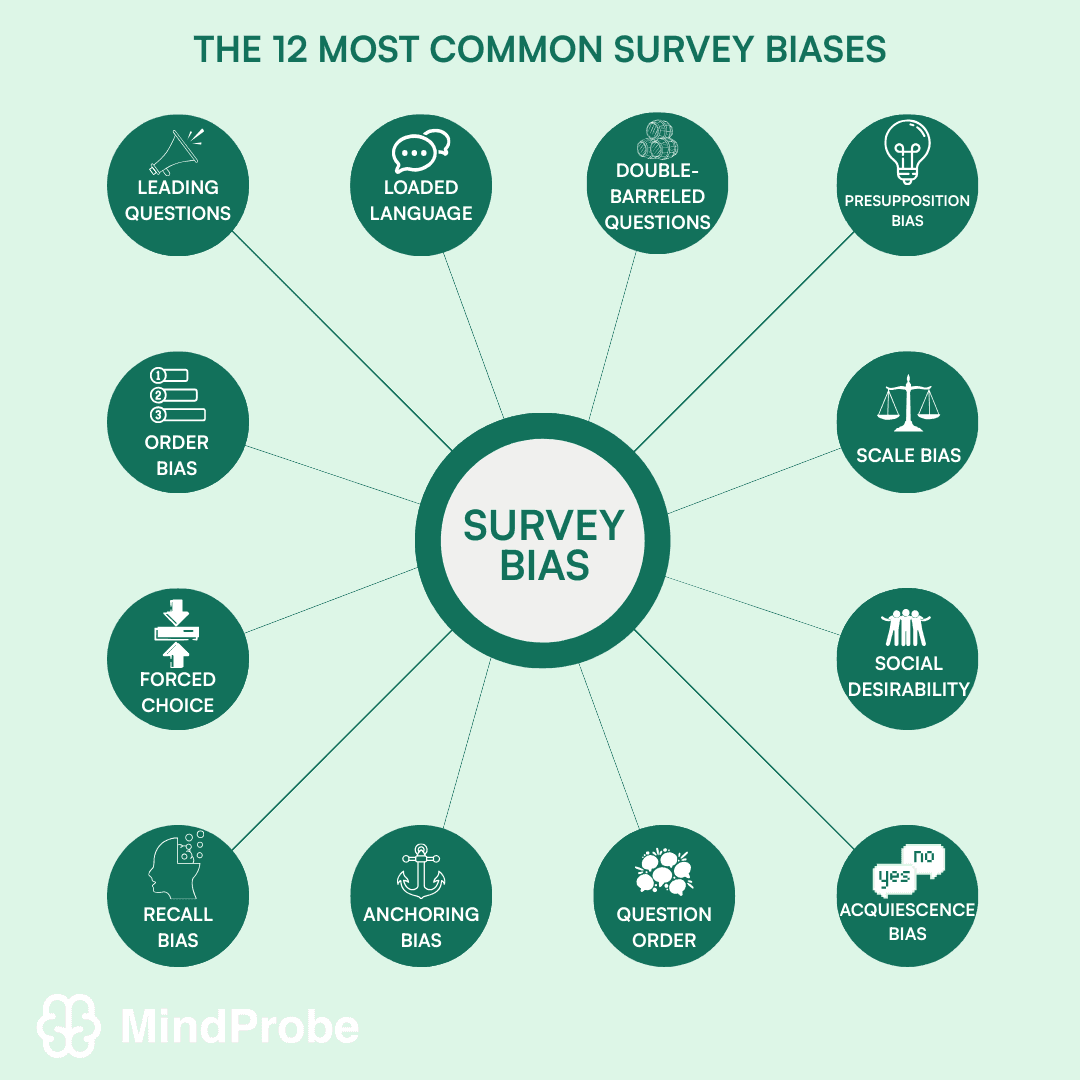
The 12 Most Common Survey Question Biases
Bias 1: Leading Questions
Definition: Questions that suggest a "correct" answer or guide respondents toward particular responses.
Examples:
❌ Biased: "How satisfied are you with our excellent customer service?"
- "Excellent" leads respondents to agree
✅ Unbiased: "How would you rate our customer service?"
- Neutral, no suggested answer
❌ Biased: "Don't you think our prices are reasonable?"
- "Don't you think" pressures agreement
✅ Unbiased: "How would you describe our pricing?" (open-ended)
OR "Do you consider our pricing to be:" [Above market / At market / Below market]
❌ Biased: "How much has our innovative new feature improved your workflow?"
- Assumes improvement happened and feature is innovative
✅ Unbiased: "Has [feature name] changed your workflow?"
- If yes: "How has it changed?" [Improved / Made worse / Changed but neither better nor worse]
Why It Happens:
Teams are proud of their work and unconsciously frame questions to validate decisions already made.
How to Avoid:
Remove all adjectives praising your product/service. Let respondents provide the evaluation.
Bias 2: Loaded Language
Definition: Words that carry strong emotional connotations that bias responses.
Loaded Words to Avoid:
Positive Loading:
- Innovative, revolutionary, groundbreaking
- Excellent, superior, premium
- Easy, simple, effortless
- Modern, cutting-edge, advanced
Negative Loading:
- Cheap, outdated, complicated
- Difficult, frustrating, confusing
- Basic, limited, inferior
Examples:
❌ Biased: "Would you recommend our revolutionary AI-powered platform?"
- "Revolutionary" and "AI-powered" create positive bias
✅ Unbiased: "How likely are you to recommend our platform?" (0-10 NPS scale)
❌ Biased: "How frustrating was the complicated setup process?"
- Assumes it was frustrating and complicated
✅ Unbiased: "How would you describe the setup process?"
OR "Rate the setup process:" [Very easy / Easy / Neutral / Difficult / Very difficult]
Detection Method:
Read your question aloud. If it sounds like marketing copy, it's biased.
Bias 3: Double-Barreled Questions
Definition: Questions that ask about two different things simultaneously, making it impossible to know which the respondent is answering about.
Examples:
❌ Biased: "How satisfied are you with our product quality and customer support?"
- Can't tell if they're rating quality, support, or both
✅ Unbiased: Split into two questions:
- "How satisfied are you with our product quality?"
- "How satisfied are you with our customer support?"
❌ Biased: "Is our pricing fair and competitive?"
- Fair and competitive are different concepts
✅ Unbiased:
- "Do you consider our pricing to be fair?"
- "How does our pricing compare to competitors?"
❌ Biased: "Should we add mobile app features and improve email notifications?"
- Two separate requests bundled together
✅ Unbiased:
- "Should we prioritize mobile app features?"
- "Should we prioritize email notification improvements?"
Why It Happens:
Trying to shorten surveys by combining questions.
How to Avoid:
Look for "and" in questions. If present, consider splitting.
Bias 4: Presupposition Bias
Definition: Questions that assume facts not in evidence, forcing respondents to accept false premises.
Examples:
❌ Biased: "How often do you use our mobile app?"
- Assumes they use it at all
✅ Unbiased:
- "Do you use our mobile app?"
- If yes: "How often?"
❌ Biased: "What features would improve your experience?"
- Assumes experience needs improvement
✅ Unbiased:
- "How would you rate your overall experience?"
- If less than positive: "What would improve it?"
❌ Biased: "When did you notice the improvement after our update?"
- Assumes improvement occurred
✅ Unbiased:
- "Did you notice any changes after our recent update?"
- If yes: "What changed?"
Detection Method:
Identify assumptions embedded in questions. Test if question works if assumption is false.
Bias 5: Scale Bias (Unbalanced Answer Options)
Definition: Answer choices that don't provide balanced response options.
Examples:
❌ Biased Scale:
How satisfied are you?
- Extremely satisfied
- Very satisfied
- Satisfied
- Somewhat satisfied
- Neutral
(Four positive options, zero negative options)
✅ Unbiased Scale:
How satisfied are you?
- Extremely satisfied
- Somewhat satisfied
- Neither satisfied nor dissatisfied
- Somewhat dissatisfied
- Extremely dissatisfied
(Balanced: two positive, one neutral, two negative)
❌ Biased: "How would you rate our product?"
- Excellent / Good / Average / Poor
(Three positive/neutral, one negative)
✅ Unbiased: "How would you rate our product?"
- Excellent / Good / Fair / Poor / Very Poor
(Two positive, one neutral, two negative)
Important: Numerical scales (1-5, 1-10) should have clear midpoints and equal distribution of positive/negative values.
Bias 6: Order Bias
Definition: The order of answer choices influences responses.
How It Manifests
Primacy Effect:
Respondents favor first options in list (especially on written surveys)
Recency Effect:
Respondents favor last options (especially on verbal surveys)
Solution:
✅ Randomize answer order (when options aren't naturally ordered)
Exception: Don't randomize when there's logical order:
- Agreement scales (Strongly Agree → Strongly Disagree)
- Frequency scales (Always → Never)
- Satisfaction scales (Very Satisfied → Very Dissatisfied)
Example:
❌ Biased: "Which feature is most important?"
(Same order every respondent, first option gets unfair advantage)
✅ Unbiased: Randomize feature order for each respondent
Mindprobe Feature: Automatic answer randomization available for non-ordered lists.
Bias 7: Social Desirability Bias
Definition: Respondents answer in ways they believe are socially acceptable rather than truthfully.
Topics Particularly Affected:
- Income (people overstate)
- Prejudice or discrimination (people underreport)
- Socially positive behaviors (people overstate)
- Socially negative behaviors (people understate)
- Health habits (people report healthier than reality)
Examples:
❌Prone to bias: "How often do you exercise?"
- People overreport to seem healthy
✅ Better: "In the past 7 days, how many days did you exercise for at least 20 minutes?"
- Specific timeframe and threshold reduces exaggeration
❌ Prone to bias: "Do you care about environmental sustainability?"
- Social pressure to say yes
✅ Better: "How much more would you pay for an environmentally sustainable version of [product]?"
- Revealed preference shows true priorities
Mitigation Strategies:
- Make responses anonymous: "Your responses are completely anonymous"
- Use behavioral questions: Ask what people did, not what they think/believe
- Provide "out" options: Include responses like "Prefer not to say" or "Not applicable"
- Indirect questioning: "What percentage of people do you think [behavior]?" (People project their own behavior)
Bias 8: Acquiescence Bias (Yes-Saying)
Definition: Tendency to agree with statements regardless of content.
Example:
❌ Prone to bias: "Do you agree that our product is easy to use?"
- Yes/No format encourages agreement
✅ Better: "How easy is our product to use?"
- Very easy / Somewhat easy / Neither easy nor difficult / Somewhat difficult / Very difficult
Key Principle:
Avoid yes/no questions for evaluative topics. Use scales instead.
Bias 9: Question Order Bias
Definition: Earlier questions influence how respondents answer later questions.
Example:
Sequence A (Biased):
Q1: "How important is environmental sustainability to you?" (Primes environmental thinking)
Q2: "Would you buy our eco-friendly product?"
(Inflated interest because Q1 primed topic)
Sequence B (Less Biased):
Q1: "Would you buy our eco-friendly product?"
Q2: "How important is environmental sustainability to you?"
(Behavioral before attitudinal)
Best Practice:
- General questions before specific
- Behavioral before attitudinal
- Unaided before aided (awareness studies)
- Most important questions first (before fatigue sets in)
Bias 10: Anchoring Bias
Definition: First number mentioned influences subsequent responses.
Example:
❌ Biased: "Our competitors charge $99. What would you pay for our product?"
- $99 becomes anchor, influences responses
✅ Unbiased: "What would you pay for a product that [description]?"
- No anchor provided
❌ Biased: "On a scale of 1-10 where 10 is extremely satisfied..."
- Starting with "10" creates high anchor
✅ Unbiased: "On a scale of 1-10..."
- Neutral presentation
Pricing Research:
Use Van Westendorp Price Sensitivity Meter (four questions at different thresholds) instead of single pricing question with anchors.
Bias 11: Recall Bias
Definition: People inaccurately remember past behaviors or experiences.
Example:
❌ Prone to bias: "In the past year, how many times did you contact customer support?"
- People can't accurately recall 12 months back
✅ Better: "In the past month, how many times did you contact customer support?"
- Shorter timeframe = better accuracy
❌ Prone to bias: "How satisfied were you with your purchase three months ago?"
- Memory degrades over time
✅ Better: Survey immediately after purchase
- Fresh memory = accurate feedback
Best Practice:
Survey close to the event. If delay is unavoidable, acknowledge it: "Thinking back to your purchase on [date]..."
Bias 12: Forced Choice Bias
Definition: Requiring answers when respondents don't have opinions or experiences.
Example:
❌ Biased: "Rate our mobile app:" (Required)
- Forces rating from people who never used it
✅ Unbiased:
- "Have you used our mobile app?"
- If yes: "Rate the app:"
- If no: Skip to next section
Include Options:
- "Not applicable"
- "Don't know"
- "No opinion"
- "Prefer not to say"
Mindprobe Feature: Display logic automatically skips irrelevant questions based on previous answers.
Framework: Writing Unbiased Questions
Step 1: Start with Clear Research Objective
Before writing any question, answer:
- What decision will this data inform?
- What specifically do we need to know?
- Who is the target audience?
Bad Process: Write questions about topics you're curious about
Good Process: Write questions that answer specific research objectives
Step 2: Draft Question Neutrally
Formula:
[Question stem] + [Neutral framing] + [Balanced options]
Question Stem Examples:
- "How would you rate..."
- "How would you describe..."
- "How frequently do you..."
- "To what extent do you..."
Neutral Framing:
Remove adjectives, remove assumptions, use actual product names (not "revolutionary solution")
Step 3: Bias Check Your Draft
Run through this checklist:
- [ ] Does it contain adjectives praising our product? (Remove them)
- [ ] Does it assume facts not in evidence? (Add qualifying questions)
- [ ] Does it ask about two things? (Split into separate questions)
- [ ] Are answer options balanced? (Equal positive/negative)
- [ ] Does it lead toward a particular answer? (Rephrase neutrally)
- [ ] Would someone who hates our product find it easy to answer honestly? (If no, rephrase)
Step 4: Test Question with Someone Unfamiliar
Best test:
Ask a colleague unfamiliar with the project to:
1. Read the question
2. Explain what you're trying to learn
3. Identify any words that seem biased
If they can't easily identify bias, question is likely neutral.
Step 5: Pilot Test with Small Sample
Before full launch:
- Send to 20-50 respondents
- Review responses for patterns
- Check if answer distribution seems realistic
- Revise if needed
Red Flags:
- 90%+ choosing one answer (unless expected)
- Confusion in open-ended responses
- High skip rates on non-optional questions
Unbiased Question Templates by Type
Customer Satisfaction
❌ Biased: "How happy are you with our amazing service?"
✅ Unbiased:
"How satisfied are you with [specific service]?"
- Very satisfied
- Somewhat satisfied
- Neither satisfied nor dissatisfied
- Somewhat dissatisfied
- Very dissatisfied
Net Promoter Score (NPS)
✅ Standard, Unbiased:
"How likely are you to recommend [company/product] to a friend or colleague?"
- Scale: 0 (Not at all likely) to 10 (Extremely likely)
Follow-up:
"What is the primary reason for your score?"
(Open-ended, neutral)
Product Feature Evaluation
❌ Biased: "How much do you love our innovative new dashboard?"
✅ Unbiased:
"How would you rate the new dashboard?"
- Excellent / Good / Fair / Poor / Very Poor
"Has the new dashboard changed your workflow?"
- Made it better / No change / Made it worse / Haven't used it yet
Purchase Intent
❌ Biased: "Would you buy our affordable solution?"
✅ Unbiased:
"How likely are you to purchase [product description] at [price point]?"
- Extremely likely / Somewhat likely / Neither likely nor unlikely / Somewhat unlikely / Extremely unlikely
Usage Frequency
❌ Biased: "How often do you enjoy using [feature]?"
✅ Unbiased:
"How often do you use [feature]?"
- Multiple times per day / Daily / Weekly / Monthly / Less than monthly / Never
Importance Rating
❌ Biased: "How critical is [feature we're proud of]?"
✅ Unbiased:
"How important is [feature] to you?"
- Essential / Very important / Moderately important / Slightly important / Not important
Open-Ended Feedback
❌ Biased: "What do you love most about our product?"
✅ Unbiased:
"What are the main strengths of our product?"
"What are the main weaknesses of our product?"
(Ask both, not just positive)
Or even better:
"What would you change about our product if you could?"
(Neutral, allows positive feedback "nothing" or constructive criticism)
How Mindprobe Helps You Avoid Bias
AI-Suggested Questions
How It Works:
Describe your research goal in plain English. Mindprobe's AI generates methodologically sound, unbiased questions.
Example: Your Input: "I want to measure satisfaction with our new checkout process"
Mindprobe AI Generates something similar to this:
1. "Have you used our checkout process in the past 30 days?" (Yes/No screening)
2. "How would you rate the checkout experience?" (5-point scale)
3. "What aspect of checkout worked well?" (Open-ended)
4. "What aspect of checkout could be improved?" (Open-ended)
5. "How does our checkout compare to other sites you've used?" (Comparative scale)
Benefit: Questions are pre-vetted for bias by methodology experts and AI trained on thousands of surveys.
Expert-Designed Question Repository
Mindprobe's Question Bank includes:
- 500+ validated question templates
- Organized by research objective
- Pre-tested for bias
- Industry-specific variations
- Best practice examples
Categories:
- Customer Satisfaction (NPS, CSAT, CES)
- Product Feedback
- Purchase Intent
- Brand Perception
- Usage & Behavior
- Demographics
- Market Research
Example Use:
Need to ask about pricing perception? Search "pricing" in question bank, see 15 neutral variations used successfully by other companies.
Pre-Built Survey Templates
Templates Include:
- Post-Purchase Satisfaction
- Product-Market Fit
- Feature Validation
- Brand Awareness Study
- Churn Risk Assessment
- Onboarding Experience
- Support Satisfaction
Each Template:
- Uses unbiased question language
- Includes proper logic flow
- Has balanced answer scales
- Contains explanatory notes on methodology
Customization:
Templates are starting points. Adjust company/product names, but core question structure remains unbiased.
Advanced: Bias in Different Question Types
Multiple Choice Questions
Keys to Unbiased Multiple Choice:
Exhaustive Options:
Include all reasonable answers
❌ Biased: "Why did you choose our product?" [Quality / Price / Brand]
(Missing options)
✅ Unbiased: Add "Features / Customer service / Recommendation / Other"
Mutually Exclusive:
Options shouldn't overlap
❌ **Biased:** [Small business / Startup / Company with 1-50 employees]
(Overlap between categories)
✅ **Unbiased:** [1-10 employees / 11-50 employees / 51-200 employees]
Include "Other":
Always provide escape hatch for answers you didn't anticipate
Rating Scales
Consistency:
Use same scale throughout survey
❌ **Biased:** Mix 1-5, 1-10, 0-10 scales
(Confuses respondents)
✅ **Unbiased:** Choose one scale, use consistently
Clear Labels:
Label all points or just endpoints
✅ **Endpoint labeled:** "Not at all likely (0) ... Extremely likely (10)"
✅ **All points labeled:** Each number has descriptor
Avoid: Labeling some but not all middle points
Matrix Questions
Bias Risk:
Respondents rush through, answer same for all rows
Mitigation:
- Limit to 5-7 rows maximum
- Randomize row order
- Include attention check: "Please select 'Agree' for this item"
- Make columns horizontal on mobile
Demographic Questions
Standard formats prevent bias:
Age:
✅ Ranges: 18-24, 25-34, 35-44, 45-54, 55-64, 65+
Income:
✅ Ranges with "Prefer not to say" option
✅ Adjust ranges for country/region
Gender:
✅ Male / Female / Non-binary / Prefer to self-describe / Prefer not to say
Company Size:
✅ Employee count ranges
✅ Revenue ranges (for B2B)
Mindprobe Library: Pre-formatted demographic questions following best practices
Common Scenarios and Solutions
Scenario 1: Testing New Feature
Goal: Determine if users want proposed feature
❌ Biased Approach:
"How excited are you about our upcoming AI-powered analytics feature that will save you hours of work?"
✅ Unbiased Approach:
1. "Are you currently doing [task feature would address]?" (Yes/No)
2. "How often?" (Frequency scale)
3. "How much time does it take?" (Time estimate)
4. Show feature description (neutral language)
5. "How useful would this be?" (5-point scale)
6. "How likely would you be to use this?" (0-10 scale)
7. "What concerns do you have about this feature?" (Open-ended)
Scenario 2: Price Testing
Goal: Determine optimal price point
❌ Biased Approach:
"Would you pay $99 for our product?"
(Anchors to $99)
✅ Unbiased Approach:
Van Westendorp Price Sensitivity:
1. "At what price would this product be so expensive you wouldn't consider it?"
2. "At what price would you consider it expensive but might still consider it?"
3. "At what price would you consider it a bargain?"
4. "At what price would it seem too cheap that you'd question the quality?"
(Four questions reveal price range without anchoring)
Scenario 3: Competitive Positioning
Goal: Understand how you compare to competitors
❌ Biased Approach:
"How much better is our product than [Competitor]?"
(Assumes you're better)
✅ Unbiased Approach:
1. "Which products are you familiar with?" (Multiple select including yours and competitors)
2. "Which have you used?" (Subset of above)
3. "Rate each on [attribute]:" (Same scale for all)
4. "Which do you prefer overall?" (Forced choice)
5. "Why?" (Open-ended)
Scenario 4: Post-Purchase Feedback
Goal: Measure satisfaction and identify issues
❌ Biased Approach:
"How thrilled are you with your purchase?"
✅ Unbiased Approach:
1. "How satisfied are you with your purchase?" (5-point scale)
2. "How well did the product meet your expectations?" (Exceeds/Meets/Below)
3. "What aspects met your expectations?" (Open-ended)
4. "What aspects fell short?" (Open-ended)
5. "How likely are you to purchase from us again?" (0-10)
Quality Control: Review Checklist
Before launching any survey, review against this checklist:
Question-Level Review
- [ ] No adjectives praising our product/service
- [ ] No assumptions about user behavior
- [ ] No double-barreled questions
- [ ] Each question asks one thing only
- [ ] Answer options are balanced
- [ ] Scales have clear midpoints
- [ ] "Not applicable" / "Don't know" options included where appropriate
- [ ] No leading language
- [ ] Neutral tone throughout
Survey-Level Review
- [ ] Most important questions early
- [ ] General before specific
- [ ] Behavioral before attitudinal
- [ ] Logical flow (no jarring transitions)
- [ ] Mobile optimized
- [ ] Estimated completion time under 10 minutes
- [ ] Clear instructions
- [ ] Professional appearance
Logic Review
- [ ] Skip logic functions properly
- [ ] No one forced to answer irrelevant questions
- [ ] Screening questions at start (if needed)
- [ ] Quotas set appropriately (if needed)
Test Run
- [ ] Tested on mobile device
- [ ] Tested on desktop
- [ ] Colleague reviewed for bias
- [ ] Pilot test completed (20-50 responses)
- [ ] Response patterns seem reasonable
Conclusion: Unbiased Questions Create Trustworthy Data
Survey bias is invisible but devastating. Questions that seem perfectly fine can systematically skew results, leading to expensive mistakes based on misleading data.
Learning how to write unbiased survey questions isn't optional for serious research. It's the foundation of reliable insights. Every word matters. Every assumption risks validity. Every biased question produces tainted data that compounds through analysis into wrong decisions.
Fortunately, unbiased question writing is a learnable skill. With awareness of common bias types, frameworks for neutral phrasing, and systematic review processes, anyone can craft questions that yield trustworthy data.
Tools like Mindprobe accelerate this process dramatically. AI-suggested questions, expert-designed templates, and real-time bias detection help you avoid subtle bias that even experienced researchers miss. The question repository provides proven neutral phrasings for every research objective. Pre-built templates follow best practices automatically.
The result: surveys that produce data you can trust, insights that drive correct decisions, and research that creates genuine competitive advantage through superior customer understanding.
Stop guessing what customers think. Start asking the right questions with Mindprobe and build research on a foundation of unbiased, reliable data.
Ready to eliminate survey bias? Try Mindprobe for free and access AI-suggested questions, expert templates, and bias detection tools.